
What Drives the Cost of a Forensic Accountant for an HOA?
There’s no set price tag for a forensic accountant investigating HOA fraud — cost depends on the scope of the review, the condition of the records, and how far back the investigation needs to go. Two situations that look similar on the surface can end up worlds apart in price once someone actually opens the books. Let’s walk through what really moves that number.
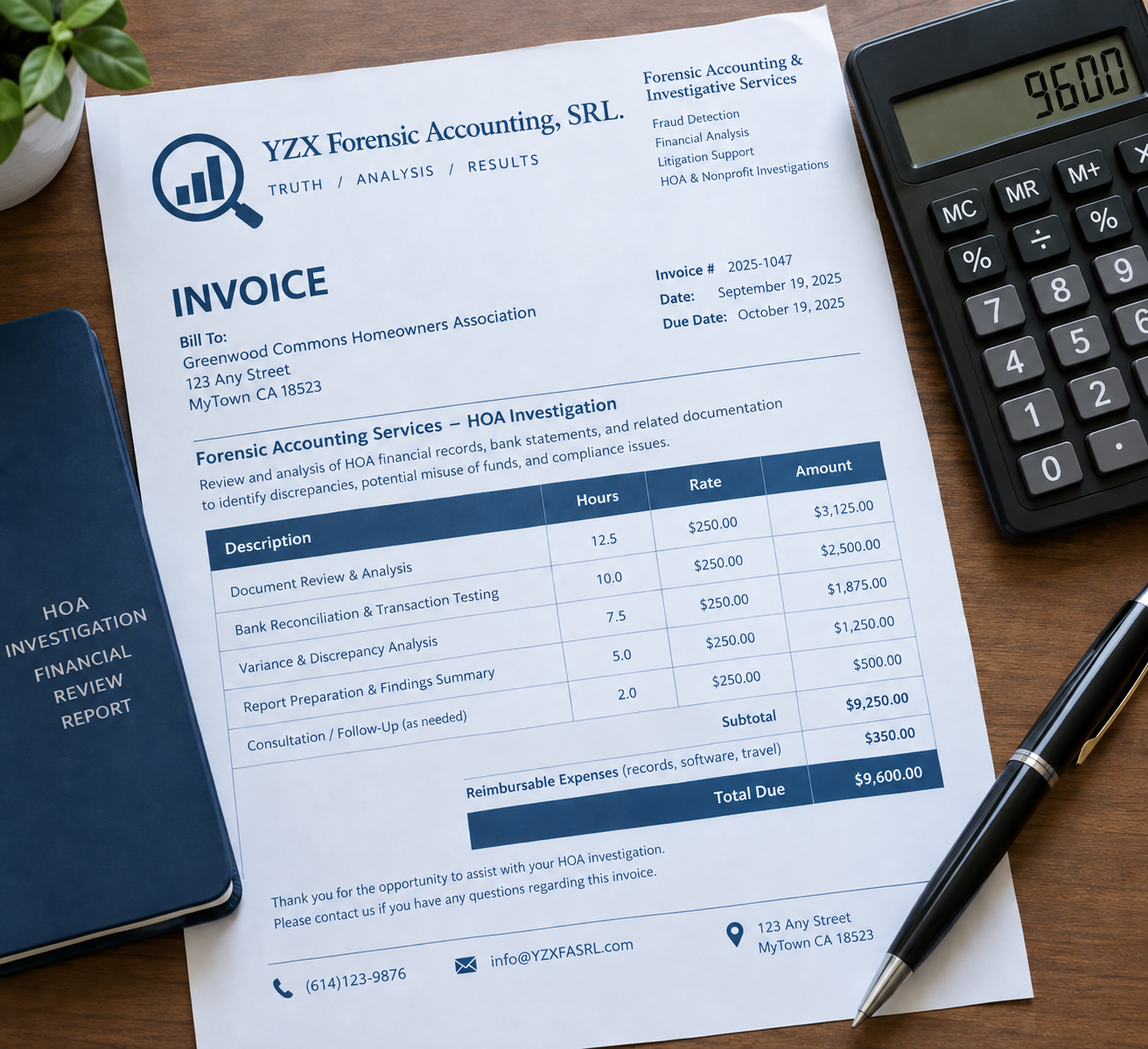
What Actually Drives the Cost
A few factors explain most of the variation homeowners run into when they start getting quotes:
- Scope of the review — a single suspicious vendor relationship costs far less to investigate than a full multi-year reserve fund audit
- Record quality — clean, organized books take less time to trace than years of missing receipts or disorganized bank statements
- Time period covered — a six-month window is a very different project than a five-year lookback
- Complexity of the suspected activity — straightforward overbilling is simpler to prove than layered self-dealing across multiple vendors or shell entities
- Whether litigation is likely — an investigation built to hold up in court generally takes more documentation and more time than one meant purely for internal board review
Two associations with the same-sized budget can end up with very different bills depending on how messy or how targeted the underlying question is.
How Forensic Accountants Usually Structure Fees
Most forensic accountants bill one of a few common ways, and it’s worth asking upfront which structure a firm uses before you commit:
- Hourly billing — the most common structure, where you’re charged for actual time spent tracing transactions and preparing findings
- Flat-fee for a defined scope — common for narrower, well-scoped engagements where both sides agree on what’s being reviewed upfront
- Retainer plus hourly — an upfront deposit against which hours are billed, common for engagements where scope might expand once the investigation starts
- Tiered packages — some firms offer set service levels (a basic review vs. a full investigation-grade report) at different price points
None of these is inherently better — it depends on whether you already know the scope or expect it to grow once someone starts digging.
Why a Real Number Can’t Come From a Phone Call
Anyone who hands you a firm dollar figure before reviewing a single document is guessing, not estimating. HOA fraud situations tend to arrive wrapped in stories — what one homeowner heard from another, what the treasurer supposedly said in passing, numbers that grow a little every time the story gets retold. None of that tells a forensic accountant what the actual records look like, and the records are what determine the price.
The same factors that drive cost — scope, record condition, and time period — are exactly what nobody can assess without opening the books first. A concern that sounds small over the phone might turn out to be thoroughly documented and quick to trace. One that sounds minor might unravel into years of scattered, incomplete paperwork once someone starts pulling bank statements. There’s no way to know which situation you’re actually in until a professional looks at what’s there.
A firm willing to give you a precise quote based on a single phone call isn’t doing you a favor — it’s setting a number nobody can responsibly promise yet. What a reputable forensic accountant can offer upfront is an explanation of how their pricing generally works, and a clear list of what records they’d need to see before scoping the engagement for real.
Ways to Keep the Cost Reasonable
A few things tend to keep engagements from running longer, and pricier, than they need to:
- Gather what records you already have before the first call. The less time spent hunting down basic documents, the more time goes toward actual analysis.
- Define the scope as specifically as possible upfront. “Look into everything” is a much bigger, costlier ask than “trace these specific vendor payments from this fiscal year.”
- Ask about a phased approach. Some firms will do an initial, lower-cost review to determine whether a fuller investigation is warranted before committing to the bigger engagement.
- Split costs among concerned homeowners, if the board itself won’t authorize the expense — this is common when a group of owners shares the same suspicion.
When It’s Worth Paying More
It’s tempting to chase the lowest quote, but the cheapest option isn’t always the smartest one here. A forensic accountant with real courtroom and litigation-support experience tends to charge more, but that experience matters if there’s any real chance the findings end up in a legal dispute — documentation standards for evidence that holds up under scrutiny are simply higher than for an internal-only summary.
Putting the Cost in Perspective
Focus less on chasing a ballpark and more on gathering what documentation you already have and defining your concern as specifically as possible. That’s the groundwork that actually shapes both the scope of an investigation and, eventually, what it costs — and it’s a far better use of your energy than hunting for someone willing to guess.